Our Small World is Getting Smaller Still

I had my first taste of international communication today thanks to Google Wave. David Alviz runs an excellent Spanish Google Wave site called WAVEsfera. He keeps up with the latest bots and gadgets, and writes very well. A while ago it might have been a small problem that his site is entirely in Spanish. Translation has been around for a while on the web now, but it involved taking note of the site and plugging it into Babelfish or something similar. Now I have translation built right into Chrome. when I visit WAVEsfera, it asks if I want it automatically translated. Similarly, I’ve subscribed to the site in Google Reader, and it translates the site for me too! So far so good, no reason not to subscribe to international sites any more!

Blue
        Marble

Then I got to thinking. I’m getting in touch with some of the people who have read First Waves, and realised that it’s the perfect chance to try Aunt-Rosie, one of the original bots released with Wave. So I fired up a wave and added WAVEsfera and the translation bot. I selected the destination language and started typing.

It was true magic.

My amazement at watching my words translated as I type is like that of a caveman witnessing fire. the experience is so novel and potentially life changing. Imagine a world where language is no longer a barrier for communicating with anyone. Think of the potential for learning!

I’m full of excitement for the world of tomorrow enabled by real-time communication and translation. We’re so close to realising the universal translator of Star Trek that I can almost taste it.

In a site note: Inspired by my discoveries, I’ve enabled instant translation to each of my posts. I know I’ve had visitors from Germany, Ireland, the USA, France, Spain, the Czech Republic and Turkey just today! If you want to read First Waves in your language, check out the “[Translate]” button beneath each post. If you’re an international reader, I’d love to hear from you! Please leave a comment, or wave me at nunn.joshua@googlewave.com and don’t forget to add aunt-rosie@appspot.com!

Edited image from http://www.flickr.com/photos/wwworks/ / CC BY 2.0
Emaily Gets Waves Out of Wave

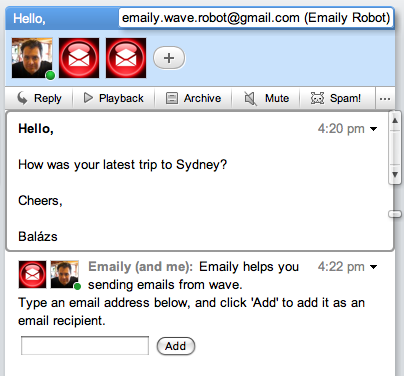
In yesterday’s open thread, I used Mr-Ray by wave.to to allow non-wavers to access a wave. Mr-Ray’s real purpose is to be an intermediary between Wavers and emailers. It does this by creating a simple wave interface when you add someone to a wave by their email address.

Well Mr-Ray wasn’t the first attempt to get Wave and Email to interoperate. A couple of Googlers used their “20% time“ to create Emaily, a bot that behaves very similarly to Mr-Ray on the Wave side, but tackles the email side of things a little differently. When you add Emaily, it first creates an email address for you on its servers. Then when you add the address of a non-waver, it sends an email to that person with the details of your update and they can reply right from their email. I have to say, it creates a pretty seamless bridge between the two worlds from the email side. In Wave though, you get to see their entire email shoehorned into a wave, with “>” reply markers and signatures left in. For anything more than simple communication back and forth this could get messy.

Picture
        1.png

The developers of Emaily have said they are planning to integrate Emaily even more into Wave by “rearchitecting Emaily into an application, which uses more of the internal Google services”. Hopefully this could be the beginning of actual built-in email capability in Wave that could speed the transition of more users from old technology to new.

Try it today. Add “emaily-wave@appspot.com” to a wave and send an email to a non-wave friend! Will extensions like Emaily and Mr-Ray help you transition to Wave any faster?

Google Wave Births "Active Robots"

An amigurumi
        robot

In my post yesterday I noted the increased push by the Wave developers to make it easier for the wave community to build and deploy extensions. It turns out this flurry of activity coincided with the imminent release of Version 2 of the Wave API, announced today.

The first new feature is the:

Active API: In v2, robots can now push information into waves (without having to wait to respond to a user action). This replaces the need for our deprecated cron API, as now you can update a wave when the weather changes or the stock price falls below some threshold. You can learn more in the Active API docs.

Google Wave Developer Blog Announcement.

If I understand this correctly (and I’m not a developer so correct me if I’m wrong) this means that before today, a robot in a wave might have had to wait until a user opened a wave before it could refresh the information in the wave (updating stocks etc), now the robot can initiate a wave update itself, making it possible to have robots create new blips in response to events. This is a much smarter way for a robot to behave, and should make for far more interesting and functional bots.

For a more enlightened perspective from a wave developer, check out Mastering Wave’s take on the announcement.

So what I initially thought was just a push to get developers involved was actually leading to an announcement of a massive upgrade to the API. In the end though, the aim is the same - to get developers engaged and creating interesting software to make Wave an indispensable tool.

Google Wave Developer Blog: Introducing Robots API v2: The Rise of Active Robots.

Image by http://www.flickr.com/photos/avoiretc/ / CC BY 2.0

Submitty and Gadgitty - Two Bots to Help Wave Developers

Recently, the Wave Team have made a big push to publicise more bots and extensions. In a post to the Google Wave Help forum, Kylie announced that some users might start seeing a new Extensions link in their navigation panel. Then enterprising Wavers noted that anyone could get access to this Extension information with a search for [<a title=“Search on Google Wave for Extensions” href=“https://www.google.com/accounts/ServiceLogin?service=wave&passive=true&nui=1&continue=https%3A%2F%2Fwave.google.com%2Fwave%2F&followup=https%3A%2F%2Fwave.google.com%2Fwave%2F&ltmpl=standard”>group:google-wave-extension-gallery@googlegroups.com].

Now Google have made it easier than ever to submit an extension to the Wave Extension review team using a simple bot.

submitty.PNG

Create a new wave and add the Submitty bot (submitty-bot@appspot.com), and Submitty will create a submission form for you to fill out. At the bottom are a couple of checkboxes. If you check either of these boxes, you’ll be prompted to fill in more information about your bot and/or gadget. Finally, you add the Extension Review Group (google-wave-extensions-review@googlegroups.com) to your wave to submit your extension.

By making this process easier, the Wave team hopes to encourage development of extensions to rapidly build up an ecosystem around Wave. Without a varied and useful set of apps, Wave will remain no more than a fun experiment.

Which also explains their dedication to an extensive and open API which they continue to enhance with supporting bots. In addition to the Submitty bot, they have released Gadgitty, a bot for editing your gadgets inline and seeing the results straight away.

Between these two bots and the others submitted by the Google Wave APIs Team, it’s obvious how important developers are to the creators of Wave, and I hope it spurs further experimentation from the wave community.

Karma: A Way to Keep Wavers In Line?

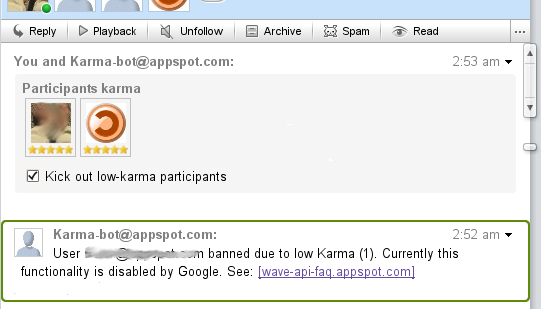
Here’s a neat little gadget/bot combo that could prove very useful for public waves if the system caught on.

Add the Karma Gadget and Bot to your waves and use it to rate your users (out of five stars). If users get consistently low scores, they will be automatically kicked from Waves that choose to turn on this option.

Karma Rating Gadget

Of course there are some potential problems with such a tool: if a user expresses unpopular views in one wave and gets poor ratings, they might find themselves banned from any future wave that uses the tool, regardless of the subject. If the tool took off in popularity it could be quite horrible to find yourself on the end of such banishment.

On the other hand, if the tool doesn’t get popular it would be unreliable for crowdsourcing opinions, letting in known trolls who had just not been rated on enough waves.

Despite these shortcomings however, I would love to see this developed further (and even be integrated as part of the official spam-fighting tools of Wave), as I see great potential in harnessing the opinions of others in keeping waves free from known trolls and spammers.

One potential use case is the immediate banishment of those frustrating bots that pop up all over the place (Kanye-bot anyone?). I’m uncertain whether bots are in the firing line (Karma-Bot itself seems immune and doesn’t show up in the rating gadget). I’m also unclear about what happens if something like the public group (which can be rated) gets consistently bad reviews.

As of writing, the gadget does not carry out bans and won’t until Google implement the kick-out feature. I will be following this tool as it develops, and I’ll be looking for opportunities to use it. And if you see me on a wave that uses Karma, please be nice!

Karma: A Reputation Rating System for Google Wave Users.

Wave To Posterous

Google fan Lookon has created a Bot to post to his Posterous blog, and written detailed instructions on how to do it.

It’s straight forward enough, add the bot and log in to the form it gives you. The next time you add the bot to a wave, the first wavelet gets posted at Posterous and it returns the URL for you to check.

Posterous seems to have the most diverse posting options of any blogging software available, and the addition of posting from waves puts it again at the forefront.

Now the bot needs to monitor comments and return them to the original wave for even tighter integration.

How to write a blog using Google Wave Robot for Posterous [Western Bridge over Google Wave]

(via Kerrie Anne’s Fridge Magnets)

Trick or Treat [Extension]

First, the extension installer gives you an option in your New Wave menu to “Go Trick or Treating”. When you click that, it creates a new wave and inserts a gadget (try clicking around that to see what surprises await). Then, whenever a user types ‘trick or treat’, the robot fetches an image from Google Image Search for either a yummy candy bar, or well, something not that yummy.

From the Google Wave Developer Blog\

No one I know has ever celebrated Halloween (it’s relatively new in Australia), and I say “Bah humbug!” (wrong holiday I know). But for those of you who want to get into the spirit of it (bad pun I know), but don’t want to leave Wave, this might be for you.

Trick or Treat Extension

Add characters quickly to a wave

Wave has a WYSIWYG interface for styling your blips. For those of us used to working on the web however, the default Bold/Italic/Dot-point tools can leave a lot to be desired. Many wont have a character pallet handy, or remember the windows/mac keyboard codes for producing various glyphs either. But if you’ve worked on the web long enough, you might be familiar with HTML/unicode character entities such as &amp; (&) and &bull; (•).

If you need to add various characters to your waves, and are familiar with HTML entities, then the Character Entity bot might be what you need. Add character-entityappspot.com@ to your wave, and whenever you write a character (in the format &code;) the bot will happily convert the code into the correct characters for you.

Here are a few to try:

  • &copy; becomes ©
  • &harr; becomes ⟷
  • &there4; becomes ∴

A more detailed list can be found at W3 Character Entity Reference Chart

Character Entity Bot [Google Code]

Emaily: An important first step.

Emaily is a bot that sends an email alert for every new blip in a specified wave.

If your main inbox is your email inbox then this bot could be an important part of your wave testing, at least until Wave catches on with more of your personal network. Instead of keeping Wave open all day, have this bot send you a ping when anyone updates the important waves.

One day though I hope to see the flow reversed, and email will flow in and out of Wave instead.

Emaily [Wave Sample Gallery]

Votely - Votes for public Waves

Using the WaveVotely bot, people can vote on which public waves are useful or fun. The results are collated at the Waverz site.

Votely - Votes for public Waves

Embed and Extend

The Google Wave APIs come in two flavors: Embed and Extensions. With Embed, you’re able to bring waves into your own site through a simple JavaScript API. For example, embedding a wave in a webpage is a good way to encourage a discussion among the visitors. With Extensions, you’re able to write programs, which are packaged as Robots or Gadgets, that provide rich functionality inside the Google Wave web client.

Introducing the Google Wave APIs

Wave the Platform

This is Google Wave as a Platform, one of the “Three Ps” of the Wave. The API gives developers a way to plug in to the Wave product and offer new and interesting ways of using waves. For instance at the preview, a software robot developed using the API could be added to a conversation to translate your waves in real-time into other languages.

I’ll be covering more of the ways the API can be used in later posts, but for now I’ll say it’s powerful way to make an already compelling product even more useful.

Google wants developers creating value to add to their product on day one. Hopefully someone enterprising will use the API to bridge the gap between email and waves unless Google does it first.